get correct picture
text written by Edgie as living memorial; 07/09/2013 |
|
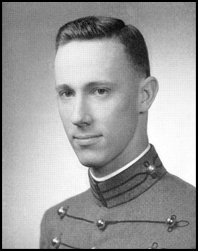 |
James Edgerton (Edgie) Waller
No. 22117
|
| |
address specifics
|
James Edgerton "Edgie" Waller was the
son of Dr. Charles F. Waller, a Miami physician and medical officer
during WWI, and Willa Shaver Waller, a naturalized U. S. citizen
from Canada. Edgie spent four years at Sewanee Military Academy,
a varsity swimmer and band commander. Passing the entrance exams
for West Point his senior year with classmate, Tom Davies, Edgie
attended Sullivan School, rooming with Davies, until his father
became ill. Enlisting in the U. S, Army, he was transferred from
Camp Gordon to USMAPS at Stewart Field. He received a congressional
appointment from FL Rep. Bill Lantaff and entered the Academy in
1954. A G-2 file in the Lost 50's, Edgie sang in barracks and in
the Cadet Chapel Choir. He became a Corps Squad swimmer, winning
the Navy Star after his medley team broke the pool and Academy records
and the team proceeded to sink Navy. During First Class summer,
he instructed the Class of 1960 in Infantry attack tactics and water
skiing at Camp Buckner.
Choosing Infantry, Edgie joined the 1/187th Infantry of the 82nd
ABN at Fort Bragg where he served with numerous classmates. During
this assignment, he was sent to the Arctic Warfare School (winter
operations & ski instructor), an eye-opening experience for
a Floridian. He became impressed by the discipline and efficiency
of airborne support units and recognized the importance of the Rapid
Deployment Logistics concept. In 1960 he transferred to QM and attended
the Airborne Rigger school at Ft. Lee. Upon completion, he was assigned
to the staff and faculty as the Assistant Chief, Aerial Delivery
Branch and then Chief, Parachute Packing Branch. In 1961, volunteers
were needed as military advisors for ARVN field forces. His marriage
having ended in divorce, Edgie volunteered and was assigned as the
senior Quartermaster advisor of II Corps where he was responsible
for logistical support of combat and counterinsurgency operations
for allied and U. S. ground and air units in ARVN II Corps zone.
He was promoted to Captain and became the aide to the Corps Senior
Advisor in addition to his duties with the II Corps staff and QM
units throughout central VN. Several aggressive actions he took
to interdict enemy supply lines and improve logistics for allied
forces were cited in MACV communications from CINCPAC. ARVN recognized
his contributions to the training and motivation of ARVN officers
and improvement in unit performance with a Letter of Appreciation.
In October, 1962 all U. S. Army Rangers in Viet Nam were ordered
to prepare for the invasion of Cuba. He completed his VN tour after
the USSR withdrew its nuclear missiles from Cuba.
Returning to Ft. Lee on leave to visit his two children,
he was asked by the CG to give a situation briefing to the command
and staff for the ARVN II Corps AO. The CG cancelled his leave,
issued him a uniform, and ordered him flown to Ft. Bragg to brief
the command and staff of XVIII Airborne Corps. He was subsequently
posted as Chief, Engineering Branch, Airborne Test Activity, Yuma
Proving Ground and assigned as project test officer for aerial delivery
tests of the Airborne Armored Reconnaissance Vehicle (General Sheridan
tank), the successful completion of which was of special interest
to President Kennedy. Edgie spent several weeks training with Air
Force and NASA personnel in heavy load C130 takeoff procedures and
parachute extraction and deployment techniques for the Apollo command
module. After five successful, fully-instrumented parachute drops
of the 37,000 pound load, he reported that the AARV aerial delivery
system and procedures were ready for deployment without further
testing. He was awarded a Certificate of Achievement by the Army
Materiél Command. He was then assigned to the U. S. Strike
Force Command Joint Test and Evaluation Task Force to evaluate Army
and Air Force airborne logistics operations during Operation Swift
Strike III for which he received a Letter of Commendation from the
task force commander, MG William B. Rosson.
Edgie resigned his commission to become a structural
engineer with Connell Associates, Inc., Miami, where he participated
in the design of many NASA missile launch facilities and other defense-related
facilities. He married Marianne Dümmerling from Karlsrühe,
Germany and adopted her two daughters, Patti and Terri. After receiving
the MSCE from the University of Miami, he became an Associate and
Head of the Computer Department at Connell. In 1974, he and Marianne
and their daughters moved to a ranch in the Cumberland Mountains
in Tennessee. He started his own engineering company and consulted
with several structural firms around the country designing, among
other structures, the Mexico Pavilion and Oddessy Restaurant at
EPCOT, the Ballpark for the Baltimore Orioles at Camden Yards, the
Galleria at Erieview, Cleveland, OH, and the Washington Redskins
Stadium, Landover, MD. He obtained two patents for tornado safe
rooms and was founding president of Remagen Corporation, Monteagle,
TN, which manufactures residential, school, and community tornado
shelters nationwide. He expanded shelter designs to resist blasts
of 155mm M107 rounds detonated at 40 feet and founded Bastogne Blast
Protection, LLC in partnership with a long established TN metal
fabricating company designing and manufacturing blast and ballistics
resistant products and buildings utilizing his innovative thin inertial
blast wall technology. Edgie's son, Cliff, from his first marriage,
was killed in 1998 while serving at headquarters of the U. S. Eighth
Army under MG Bill Lennox.
During his lifetime Edgie remained an active member
of the United Methodist Church, serving as a Trustee and member
of the choir, and in Rotary International, serving two terms as
president of his local club. He was the founding president of the
National Storm Shelter Association, serving six years as president.
He was a member of the International Code Council committee for
the development of the ICC/NSSA storm shelter design standard. Edgie
was guided by two main principles, at West Point and in his military
and business life - "Do unto others as you would have them
do unto you" and "Proceed as though you know what you're
doing". He is survived by XXXXXXXXXXXXXXXX
XXXXXXXXXXXXXXXXXXXXXXXX
XXXXXXXXXXXXXXXXXXXXXXXX
|